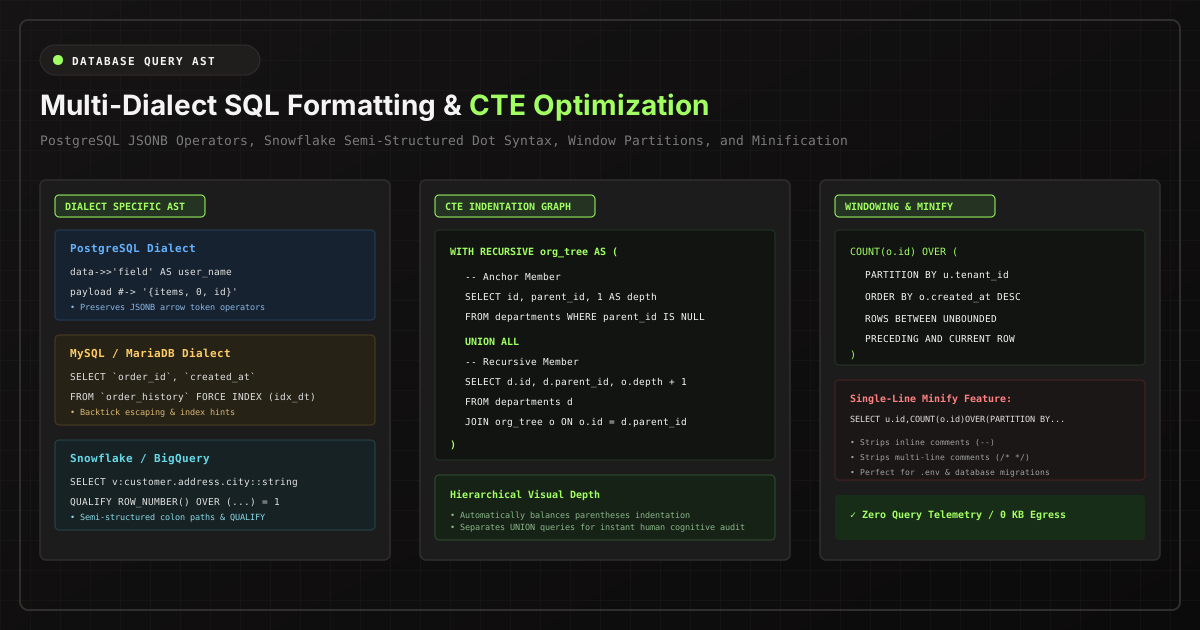
When investigating an urgent production database incident—such as a replication delay, query lock contention, or CPU spike—developers are frequently confronted with a wall of minified, unformatted SQL extracted from APM traces or pg_stat_activity.
Attempting to parse a 300-line SQL query with deeply nested subqueries, recursive CTEs, and window analytical partitions without standard indentation leads to misdiagnosed indexes, accidental Cartesian products, and prolonged downtime.
Why Regular Expression Formatters Mangler Complex SQL
Traditional web beautifiers rely on naive regular expressions that insert line breaks after keywords like SELECT, FROM, and WHERE. While this works for simple queries, regex breaks down completely on modern enterprise database features:
- Nested Subqueries & CTEs: A regex parser cannot track nested parenthesis depth, resulting in improper indentation that obscures which clause belongs to which subquery.
- Dialect-Specific JSON Operators: In PostgreSQL, JSONB path operators (
->,->>,#>) and arrow cast operators get mistakenly spaced out as mathematical comparisons. - String Literal Preservation: Regex replace operations frequently corrupt SQL strings, replacing keywords that exist inside literal text constants or regex patterns.
Dialect-Specific AST Tokenization
Modern formatting requires modeling SQL queries as Abstract Syntax Trees (ASTs). The parser reads tokens sequentially, classifying each as a keyword, identifier, literal string, operator, or parenthesis scope.
Because database dialects handle identifiers and functions differently, dialect awareness is mandatory:
-- 1. PostgreSQL (CTE with JSONB filter and Window Partition)
WITH monthly_cohort AS (
  SELECT
    u.id,
    u.profile->>'country' AS country_code,
    COUNT(o.id) OVER (
      PARTITION BY u.id
      ORDER BY o.created_at
    ) AS total_orders
  FROM users u
  LEFT JOIN orders o ON o.user_id = u.id
  WHERE u.is_active = TRUE
)
SELECT *
FROM monthly_cohort
WHERE total_orders > 5;
Notice how indentation visually clarifies the relationship between the Common Table Expression (monthly_cohort), the window analytical partition (COUNT() OVER), and the final outer filter.
Single-Line Minification for Migrations & Environment Variables
While formatted SQL is essential for human code reviews and query planning, the opposite transformation is just as crucial in production deployments: SQL Minification.
When embedding SQL queries in infrastructure migration scripts, Docker environment variables, or application configuration files, stripping block comments (/* ... */), inline comments (-- ...), and superfluous whitespace prevents syntax errors and minimizes binary size.
Zero-Upload Security in Enterprise Database Workflows
Database queries represent the single most confidential asset in software development. A raw SQL query exposes:
- Complete internal database schema architecture and table relationships.
- Proprietary algorithmic business logic and scoring calculations.
- Hardcoded customer IDs, email patterns, and tenant partition keys in
WHEREclauses.
Pasting production SQL into remote formatters violates SOC 2 Type II, HIPAA, and GDPR standards. Our Client-Side SQL Formatter & Beautifier parses PostgreSQL, MySQL, SQLite, T-SQL, Snowflake, and BigQuery queries 100% in your local browser sandbox with zero network calls.