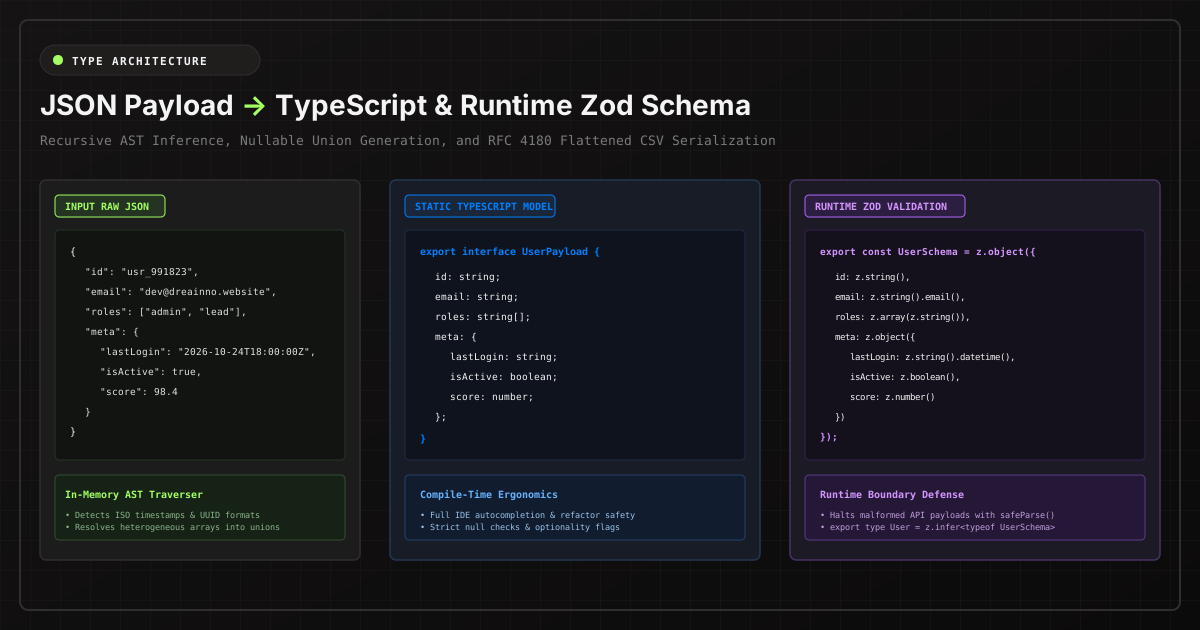
In modern web applications, JSON is the lingua franca of data exchange. Yet one of the most perilous architectural traps in modern TypeScript engineering is assuming that compile-time static types guarantee runtime payload integrity.
When your frontend receives an external API response from a third-party gateway, or when a microservice ingests a webhook from Stripe or GitHub, TypeScript types completely evaporate during the JavaScript compilation step. If the upstream service modifies a field name, nests an object, or emits null where a string was expected, your application crashes in production with the dreaded:
TypeError: Cannot read properties of undefined (reading 'map')The Compile-Time Illusion: Static Types vs. Runtime Validation
TypeScript interfaces provide developer ergonomic benefits (IntelliSense, autocomplete, parameter checking), but offer zero defense against malformed runtime input. To build resilient distributed systems, engineers must bridge the boundary between untrusted external JSON and type-safe application code.
This is where Zod has revolutionized the TypeScript ecosystem. Rather than writing manual validation functions, Zod allows you to define declarative runtime schemas that automatically infer static types:
import { z } from 'zod';

// 1. Define Runtime Schema
export const UserAccountSchema = z.object({
  id: z.string().uuid(),
  email: z.string().email(),
  role: z.enum(['admin', 'developer', 'viewer']),
  teams: z.array(z.string()),
  metadata: z.object({
    lastLoginAt: z.string().datetime(),
    loginCount: z.number().int().nonnegative()
  }).optional()
});

// 2. Automatically Derive Static TypeScript Interface
export type UserAccount = z.infer<typeof UserAccountSchema>;
With this dual-layer pattern, you parse the incoming untrusted payload using UserAccountSchema.safeParse(json). If the JSON diverges from the specification, execution halts with precise field-level validation errors before corrupt data propagates into database queries or React state.
Recursive AST Inference: Solving Heterogeneous JSON Arrays
Writing Zod schemas and TypeScript models by hand for large, deeply nested JSON payloads (such as AWS CloudTrail logs, Stripe event objects, or Kubernetes manifests) is tedious and error-prone. Naive JSON-to-TypeScript converters often fail on edge cases:
- Heterogeneous Array Unification: If an array contains
[1, "two", null], a naive parser emitsany[]. An AST-driven engine computes the union type(number | string | null)[]. - Optional vs. Nullable Property Detection: When analyzing arrays of objects where certain keys appear in some elements but are omitted in others, properties must be marked with optional flags (
?) or combined with.nullable().optional()in Zod. - Primitive Format Detection: Detecting ISO 8601 timestamps, UUID strings, and numeric ranges to emit tailored Zod validators (
z.string().datetime(),z.string().uuid()) rather than generic strings.
Data Engineering Utility: Flattening Nested JSON to RFC 4180 CSV
In addition to generating TypeScript and Zod models, developers and data engineers frequently need to transform hierarchical JSON records into flattened tabular formats for spreadsheet analysis, warehouse ingestion (Snowflake, BigQuery), or ML pipeline staging.
Flattening nested structures requires dot-notation key resolution (e.g., user.address.postal_code) and RFC 4180 compliant CSV quoting to safeguard commas, line breaks, and quotation marks within JSON strings.
The Privacy Imperative: Why Online JSON Converters Leak IP
Engineers frequently paste live production payloads into random web converters to generate types quickly. But production payloads often carry sensitive customer Personally Identifiable Information (PII), proprietary internal IDs, and private API responses. If the converter transmits that payload to a remote web server, you face immediate compliance violations under SOC 2, HIPAA, and GDPR.
Our Universal JSON Data Morph runs 100% locally in your browser. The recursive parsing engine compiles TypeScript interfaces, Zod validation schemas, and RFC 4180 CSV tables in local JavaScript heap memory with zero network egress.