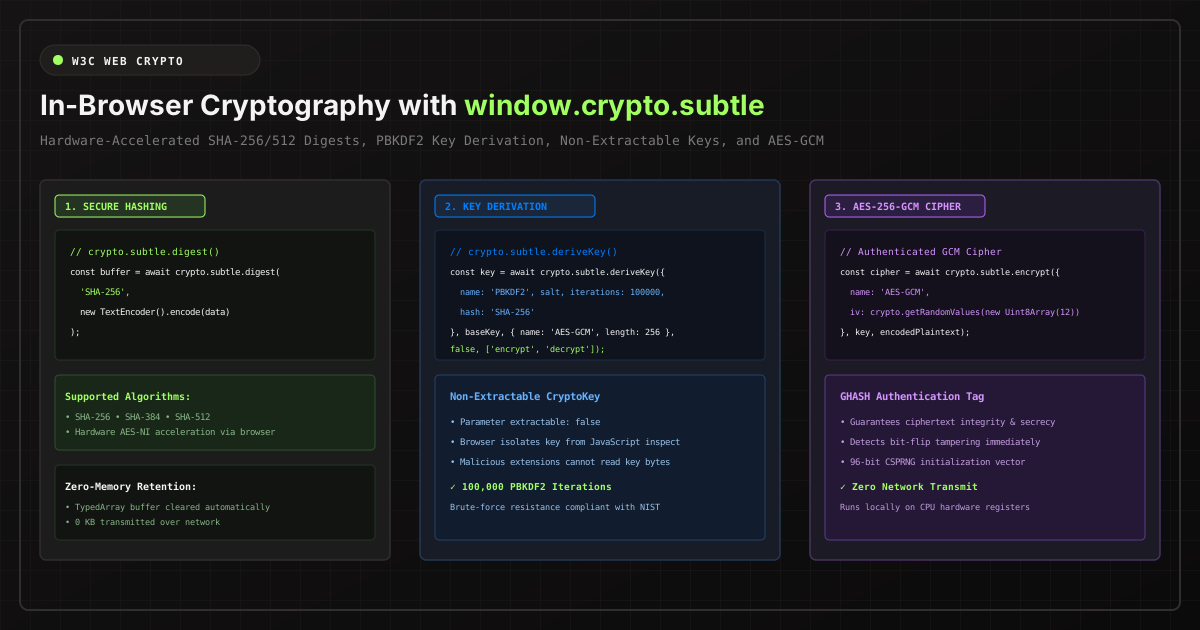
For over a decade, client-side web applications that required symmetric encryption or cryptographic hashing relied on bloated, unmaintained JavaScript libraries like CryptoJS. These pure-JS libraries suffered from side-channel timing leaks, severe garbage-collection overhead, and insecure pseudo-random number generators (PRNG).
The W3C Web Cryptography API (SubtleCrypto) fundamentally revolutionized browser security. Built natively into all modern JavaScript runtimes (Chromium, WebKit, Gecko, Node.js 18+, and Cloudflare Workers), SubtleCrypto executes cryptographic algorithms in native compiled C++ or hardware security enclaves directly on the client machine.
Why Native SubtleCrypto Beats Legacy Pure-JS Libraries
- Constant-Time Execution: Pure JavaScript cryptographic implementations cannot guarantee constant-time execution. JIT compilers optimize conditional branches, inadvertently leaking private key bits via micro-architectural timing side-channels. Native Web Crypto implementations are immune to JavaScript JIT side-channel leakage.
- Non-Extractable Keys (
extractable: false): You can import or generate a cryptographic key in browser memory while marking it non-extractable. Even if an attacker executes XSS inside your page, they cannot dump the raw secret bytes viaconsole.log()— they can only request the browser to sign or decrypt with it. - Hardware PRNG Acceleration (
crypto.getRandomValues): Native entropy sources seeded directly by the host operating system kernel (/dev/urandomon Linux/macOS,BCryptGenRandomon Windows), eliminating the disastrous predictability ofMath.random().
Implementing AES-GCM Authenticated Encryption
AES-GCM (Galois/Counter Mode) provides both confidentiality (encryption) and integrity (authentication tag). If an attacker tampers with even a single bit of the ciphertext in transit, decryption fails completely:
async function encryptAesGcm(plainText: string, password: string) {
  const enc = new TextEncoder();
  const salt = crypto.getRandomValues(new Uint8Array(16));
  const iv = crypto.getRandomValues(new Uint8Array(12)); // 96-bit IV for GCM

  // Derive 256-bit encryption key using PBKDF2 with 100,000 iterations
  const keyMaterial = await crypto.subtle.importKey(
    'raw',
    enc.encode(password),
    'PBKDF2',
    false,
    ['deriveKey']
  );

  const key = await crypto.subtle.deriveKey(
    {
      name: 'PBKDF2',
      salt: salt,
      iterations: 100000,
      hash: 'SHA-256'
    },
    keyMaterial,
    { name: 'AES-GCM', length: 256 },
    false, // Non-extractable key
    ['encrypt', 'decrypt']
  );

  // Perform authenticated encryption
  const cipherBuffer = await crypto.subtle.encrypt(
    { name: 'AES-GCM', iv: iv },
    key,
    enc.encode(plainText)
  );

  return {
    cipherTextHex: Array.from(new Uint8Array(cipherBuffer)).map(b => b.toString(16).padStart(2, '0')).join(''),
    ivHex: Array.from(iv).map(b => b.toString(16).padStart(2, '0')).join(''),
    saltHex: Array.from(salt).map(b => b.toString(16).padStart(2, '0')).join('')
  };
}
Managing Production Secrets & Zero-Trust Cloud Architecture
While client-side Web Crypto safeguards user data inside the browser isolate, backend infrastructure requires hardened secrets management:
- Self-Hosted HashiCorp Vault on KVM VPS: To maintain strict air-gapped isolation over master encryption keys, deploying HashiCorp Vault on high-frequency NVMe hardware like Hostinger KVM VPS (20% discount) provides dedicated kernel access with zero shared virtualization risks.
- Cloud Key Management Systems (KMS): For automated rotation of production database credentials and TLS certificates, provisioning enterprise nodes via DigitalOcean Cloud with $200 in free 60-day credits enables encrypted volume storage and automated database snapshots.
Test your cryptographic hashes, HMAC signatures, and Base64 payloads with complete privacy in our browser-based Client-Side Web Crypto Toolkit.