Last month, an incident post-mortem at a high-growth fintech scaleup revealed something uncomfortably common: an on-call engineer debugging an urgent database dead-lock copied a 400-line query from production logs and pasted it into a random online SQL beautifier.
Within seconds, the query was formatted. But within hours, the security team flagged an enterprise compliance violation: that single raw SQL string contained proprietary table names, internal column identifiers, customer tenant IDs, and literal WHERE constraints that traversed across an unvetted third-party cloud server.
The Hidden Cost of "Free" Online Converters
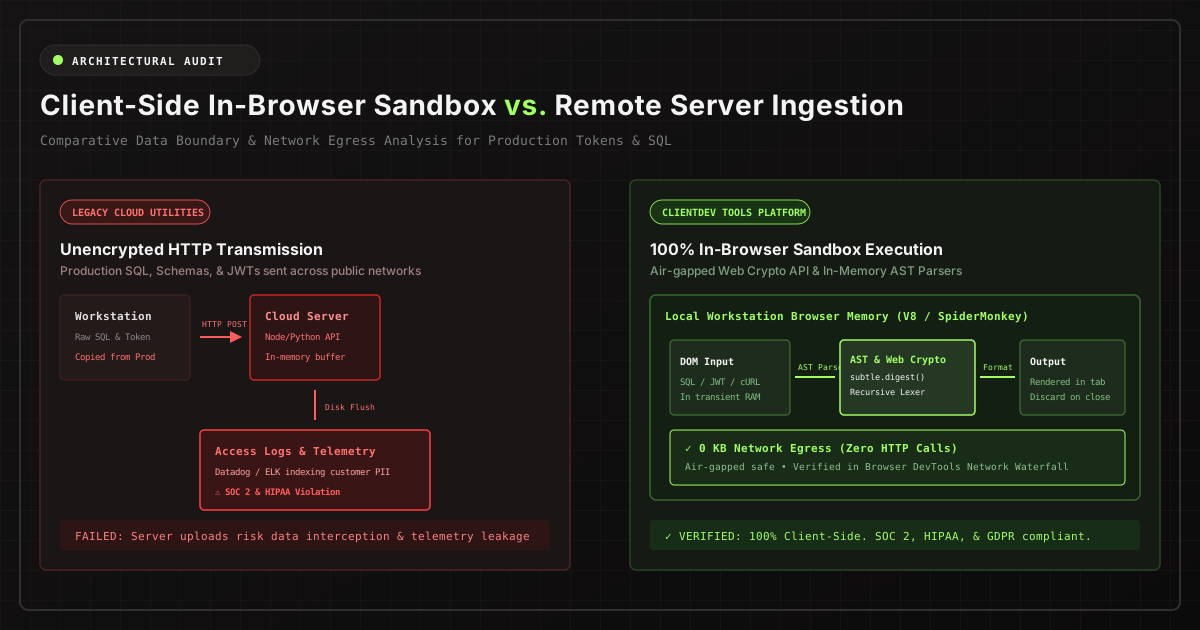
Most developers assume that online formatters, Base64 decoders, and token inspectors are benign client-side utility scripts. In reality, a large percentage of popular web utilities operate on legacy server-rendered architectures:
- HTTP POST Payload Transmission: Your code is sent to an external Node.js, Python, or Go web server via API endpoints.
- Centralized Access Logging: Standard reverse proxies (Nginx, Envoy, Cloudflare edge logs) automatically capture request bodies in debug logs, indexing them in telemetry platforms like Datadog or ELK.
- Disk Persistence & Caching: Many services cache recent transformations on server-side Redis or local disk partitions without automated TTL eviction.
If you are operating under SOC 2 Type II, HIPAA, ISO 27001, or GDPR Article 32, submitting unencrypted intellectual property or authentication tokens to untrusted third-party servers constitutes an immediate data leak.
How Client-Side Architecture Changes the Equation
The modern web platform has evolved past the need for server-side processing for text transformations. With modern Web Standards, developers can achieve sub-millisecond execution while maintaining an airtight privacy boundary:
- The Web Crypto API (
window.crypto.subtle): Cryptographic hashing, HMAC-SHA256 signature verification, and key derivation can be executed directly inside the browser's hardware-accelerated crypto sandbox. Private keys and session secrets never cross network boundaries. - In-Memory Abstract Syntax Trees (AST): Libraries like
sql-formatterand custom recursive JSON traversers compile directly into JavaScript memory. Tokens are processed locally and discarded as soon as the browser tab closes. - WebAssembly (WASM): Heavy compute engines written in Rust or C++ run in browser memory isolates at near-native speeds, eliminating the classic excuse that "complex parsing requires a backend server."
Verifying Zero-Server Execution with Browser DevTools
You should never take a developer tool's privacy claims on blind faith. Here is how any software engineer can verify that a utility is truly 100% client-side:
- Open your browser's Developer Tools (
F12orCmd + Option + I). - Switch to the Network tab and check the "Preserve log" checkbox.
- Filter requests by Fetch/XHR.
- Paste a query or token and click "Format" or "Decode".
- Observe the Network activity: on a properly architected client-side tool, zero HTTP requests will be fired. The network waterfall remains completely silent.
The DreaInno Architectural Principle
At DreaInno, our engineering principle for developer tooling is simple: Compute where the data lives. If data originates on a developer's machine, formatting and inspection must happen on that machine. There is no legitimate architectural justification for streaming developer code to a remote server simply to insert indentation or decode Base64 strings.